

How Long Should a Concrete Driveway Last? Waukee Guide
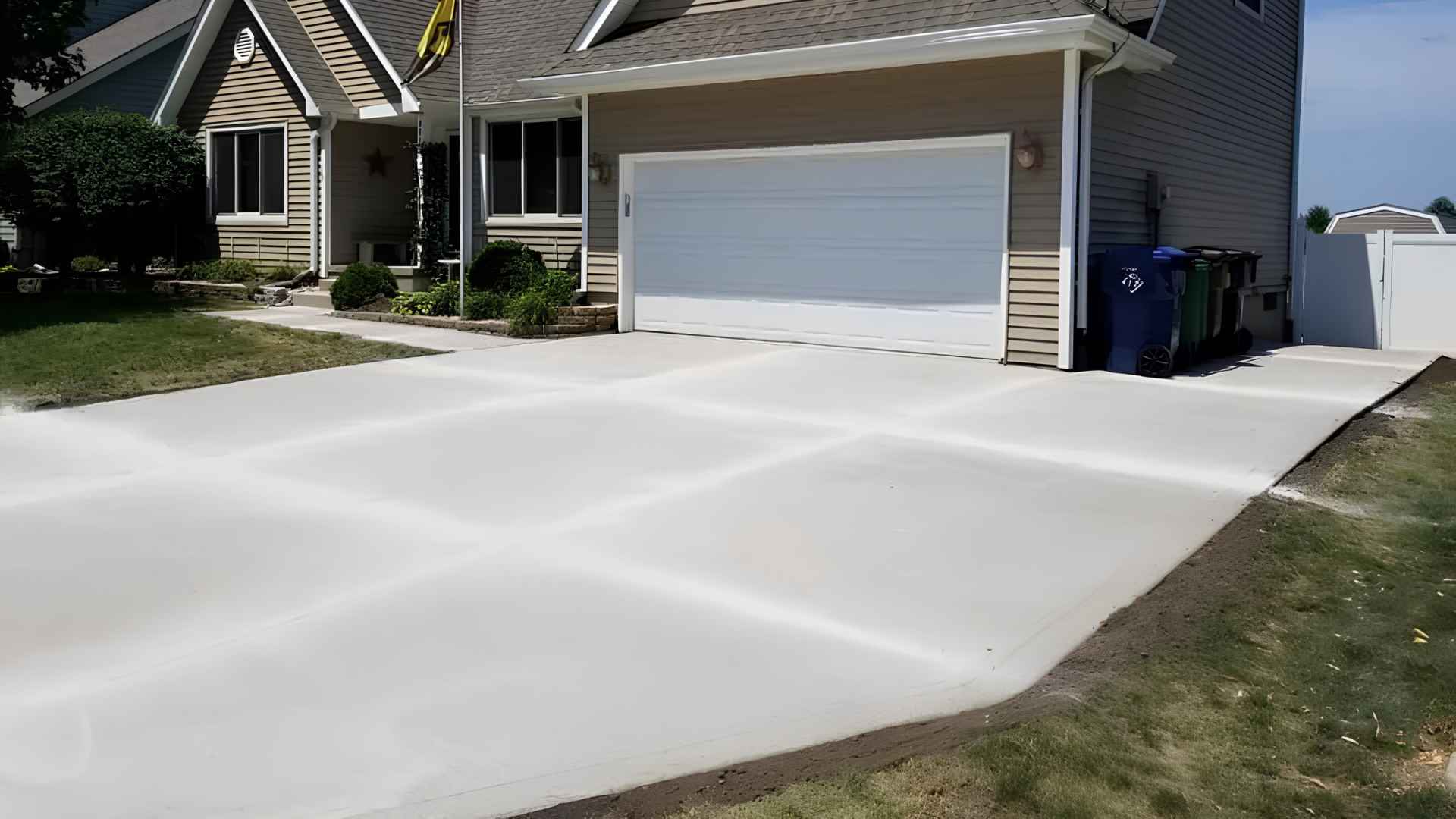
A well-built concrete driveway can last 30 years or longer, but the concrete itself is only part of the equation. For homeowners considering concrete driveway replacement in Waukee, Iowa, long-term performance depends on the soil, base preparation, reinforcement, concrete mix, placement, curing, drainage, and maintenance. When each part works together, the driveway has a much better chance of serving the home for decades.
This guide expands on Episode 6 of The Concrete Blueprint, “How Do You Replace a Driveway the Right Way So It Lasts 30+ Years?”, where Andrew Quick of Quick Concrete Solutions, a concrete contractor in Waukee on the west side of the Des Moines metro, walks through the company’s driveway replacement process step by step.
How Long Should a Concrete Driveway Last?
A properly installed concrete driveway should provide decades of service, but there is no single lifespan that applies to every property. Soil movement, water, Iowa weather, traffic loads, concrete quality, and workmanship all affect how long the slab performs.
That is why Quick Concrete Solutions treats driveway construction as a complete system rather than a simple pour.
Andrew Quick, owner, CEO, and president of Quick Concrete Solutions in Waukee, sums up the company's approach clearly: "Everything starts with a good foundation."
A driveway can look great on the day it is poured and still develop problems early if the ground underneath was poorly prepared. Long-term durability starts below the surface, continues through the pour, and depends on what happens during curing and use.
Why Does the Subgrade Matter to Driveway Longevity?
The subgrade matters because a concrete slab needs consistent support underneath it. Subgrade simply means the natural soil beneath the driveway and its aggregate base.
Once an old driveway is removed, contractors can inspect conditions that were previously hidden. Quick Concrete Solutions looks for weak soil, sand veins, drainage problems, irrigation leaks, and voids that may have developed beneath the old slab.
Those conditions need attention before new concrete covers them.
If one section rests on firm material while another sits above loose or washed-out soil, the slab can experience uneven support. Vehicle loads and seasonal ground movement can then increase the risk of settlement and cracking.
A durable driveway starts by correcting the foundation instead of hiding problems underneath fresh concrete.
What Type of Base Should Go Under a Concrete Driveway?
A concrete driveway needs a compactable aggregate base that creates a firm, stable platform for the slab. Simply spreading loose stone over the soil does not provide the same support.
Quick Concrete Solutions commonly uses what Andrew calls roadstone, an inch-and-a-half-down aggregate made up of larger stone and smaller fines. The different particle sizes help the material lock together when properly compacted.
Compaction is what turns loose aggregate into a dependable base.
Loose materials such as pea gravel behave differently because they do not compact the same way in an open driveway application. The correct material and compaction method depend on the site, which is why the conditions underneath the old driveway need to be evaluated before the new base is installed.
The goal is simple: give the concrete uniform support before it ever sees a vehicle.
Does a Concrete Driveway Need Rebar?
Rebar can help control movement and keep sections of a concrete driveway working together, but only when it is positioned correctly. Simply including steel in the bid does not guarantee effective reinforcement.
Concrete handles compression well, but slabs still move as temperatures change, soil shifts, loads pass over them, and the concrete shrinks during curing.
Reinforcement helps manage those stresses and can help hold cracks tighter when movement occurs.
Quick Concrete Solutions also builds with future loads in mind. A driveway may normally carry cars and SUVs, but it could later support moving trucks, roofing crews, trailers, or construction equipment.
Andrew points out that reinforcement sitting on the ground cannot perform the same job as reinforcement placed where it was intended within the slab.
Proper installation matters as much as the material itself.
What Are Rebar Chairs, and Why Do They Matter?
Rebar chairs are supports used to hold reinforcing steel at the proper height while concrete is placed around it. They prevent the rebar from simply resting at the bottom of the slab.
That small detail can make a meaningful difference.
Without support, workers walking through the area or concrete moving across the forms can push reinforcement out of position. Chairs help keep the steel where the contractor designed it to be.
It is one of many parts of driveway construction homeowners may never see again after the pour. Those hidden details often separate a carefully built driveway from one focused mainly on how the finished surface looks.
What PSI Concrete Is Best for a Driveway?
The best concrete strength depends on the driveway's design, expected loads, environment, and local requirements. PSI alone should not be used to judge whether a driveway will last.
PSI, or pounds per square inch, is commonly used to describe concrete's compressive strength.
Quick Concrete Solutions generally considers 4,000 PSI a minimum for its driveway work and often prefers at least 5,000 PSI when appropriate for the project.
However, strength involves more than ordering a high PSI number.
The American Cement Association's guidance on concrete mixtures explains that strong, durable concrete depends on properly proportioning cement, aggregate, water, and other ingredients. Lowering the water-cement ratio while maintaining enough workability for proper placement generally improves concrete quality.
The right mix is the one designed for the actual driveway, not simply the highest number available.
Why Can Adding Too Much Water Weaken Concrete?
Adding excessive water can reduce the strength and durability of a concrete mix by changing its designed water-cement ratio.
This often becomes an issue at the jobsite. Concrete may be harder to work with during hot weather, and crews can be tempted to add water simply to make placement easier.
Andrew describes seeing situations where 30 or 40 gallons are added to a truck, turning a properly ordered mix into a much wetter product.
The American Cement Association’s mix guidance ties the strength of the cement paste directly to the ratio of water to cement, which is why water added at the curb weakens a mix the plant designed.
Hot weather does require adjustments, but casually adding water is not the only option. The National Ready Mixed Concrete Association's hot-weather guidance recommends planning for temperature, wind, humidity, and evaporation and using appropriate mixture adjustments when needed.
Good concrete can still be compromised after the truck reaches the driveway.
Why Would a Contractor Use a Pump Truck for a Driveway?
A pump truck gives crews more control over concrete placement while helping protect the prepared base, reinforcement, and surrounding property.
Quick Concrete Solutions uses pumps on many driveway projects so concrete can be delivered directly where it is needed. That reduces the need to drive equipment across the site or disturb rebar that has already been positioned on chairs.
The pump itself does not make concrete stronger. The advantage is control.
Crews can work across the slab more deliberately and place the material without undoing preparation that has already been completed.
For homeowners comparing driveway contractors, equipment should not be judged by how impressive it looks. The better question is whether the equipment supports a cleaner, more controlled installation.
How Long Should Concrete Cure Before You Drive on It?
Quick Concrete Solutions generally recommends waiting about five to seven days before normal vehicle use, although the correct timeline depends on the mix, temperature, humidity, and other conditions.
Curing is the process of maintaining suitable moisture and temperature so newly placed concrete can continue developing its intended properties.
The American Concrete Institute explains that proper curing allows cement hydration to continue and helps concrete develop strength while limiting moisture-related changes that can contribute to cracking.
Quick Concrete Solutions typically recommends waiting longer, around 10 to 12 days depending on the application, before heavy trucks or equipment use the driveway.
The exact timeline should always come from the contractor based on the mix and conditions. The first winter matters too, so it helps to know what not to do with new concrete during its first year.
Curing is not downtime. It is part of construction.
Why Are Control Joints Important in a Concrete Driveway?
Control joints create planned locations for shrinkage cracking as concrete cures and moves. They do not guarantee a crack-free driveway, but they help control where cracks are likely to appear.
Concrete naturally changes as moisture leaves the slab and temperatures rise and fall.
Quick Concrete Solutions cuts joints while the concrete is still young enough to be sawed appropriately. Those cuts create intentional weak planes where shrinkage cracking can occur instead of wandering unpredictably across the surface.
This is why finishing a driveway involves more than smoothing the surface.
Joint layout, cutting, curing, form removal, backfilling, and site protection all affect what happens after the concrete truck leaves.
How Does Iowa Weather Affect Concrete Driveways?
Iowa's changing temperatures make moisture management, proper curing, drainage, and freeze-thaw durability especially important.
Water can enter pores in concrete and the ground around it. Repeated freezing and thawing place additional stress on exterior slabs, particularly when moisture and deicing chemicals are present.
Industry standards specifically recognize this exposure. ASTM has developed testing methods for evaluating how concrete surfaces resist scaling when exposed to freeze-thaw cycles and deicing chemicals.
That does not mean Iowa homeowners should expect short driveway lifespans.
It means exterior concrete should be designed for local conditions. The mix, drainage, foundation, curing process, and winter maintenance all need to work together. Our guide to why concrete driveways crack in Iowa covers that freeze-thaw damage in more detail.
Climate should be part of the design from the beginning, not an explanation for preventable failure later.
What Separates a 10-Year Driveway From a 30-Year Driveway?
A long-lasting driveway is usually the result of many correct decisions rather than one expensive upgrade.
The process starts with removing the old slab and inspecting what is underneath. Weak soil and drainage issues are corrected. The base is compacted. Reinforcement is properly positioned. The concrete mix suits the application. Crews avoid compromising it during placement. Joints are cut properly, and curing receives the same attention as the pour.
Andrew explains that there are plenty of ways to pour a driveway that looks good when the job is finished. There are far fewer ways to build one correctly for long-term performance.
Homeowners should therefore ask contractors about what they will never see once the slab is finished.
For anyone comparing concrete driveway replacement in Waukee, Iowa, West Des Moines or Urbandale, ask about soil evaluation, base material, compaction, reinforcement placement, concrete mix, water added on-site, control joints, curing, and drainage. Those answers reveal much more about the likely quality of the driveway than appearance alone. When you are ready to plan your own replacement, request a free estimate from Quick Concrete Solutions.
Watch the Full Podcast on YouTube
Want a closer look at what goes into building a driveway for long-term performance? Watch the full episode of The Concrete Blueprint on YouTube, where Mike Downer talks with Andrew Quick of Quick Concrete Solutions about the company's driveway replacement process. Andrew covers soil evaluation, compaction, reinforcement, mix design, pump placement, curing, and the small installation decisions that can determine how a driveway performs years after the crew leaves.
Frequently Asked Questions About Concrete Driveways
How long does a concrete driveway last in Iowa?
A properly built concrete driveway can last 30 years or longer in Iowa when the subgrade, base, reinforcement, mix, curing, and drainage are all done correctly. Quick Concrete Solutions in Waukee builds every driveway around those steps rather than the look of the finished surface.
Is cracking normal in a concrete driveway?
Yes. Concrete naturally shrinks and moves, so some cracking can occur even when a driveway is installed correctly. Proper joints, reinforcement, subgrade preparation, drainage, and curing help control that movement and reduce damaging cracks.
Is 4,000 PSI concrete strong enough for a driveway?
It can be appropriate for some residential driveways, but the correct mix depends on loads, exposure, reinforcement, local requirements, and project design. Quick Concrete Solutions often prefers at least 5,000 PSI when appropriate.
Does higher PSI mean a driveway will last longer?
Not automatically. Higher compressive strength cannot compensate for weak soil, poor compaction, bad drainage, misplaced reinforcement, excessive water, or improper curing. The entire driveway system affects longevity.
Why shouldn't rebar sit on the ground?
Rebar needs to remain at its intended position inside the slab to provide the reinforcement it was designed to deliver. Rebar chairs help hold it at that height during concrete placement.
How soon can I drive on a new concrete driveway?
Quick Concrete Solutions generally recommends waiting five to seven days for normal vehicles, depending on the mix and weather. Heavy trucks or equipment may require a longer curing period.
What do control joints do?
Control joints create planned locations for shrinkage cracking. They help direct natural movement into predictable lines rather than allowing cracks to form randomly across the driveway.
Should a new concrete driveway be sealed?
A sealer can help protect concrete from certain stains, moisture, salts, and other exposure, but product choice and timing matter. Follow the contractor's recommendation and the manufacturer's instructions for the specific sealer.
How long does driveway replacement take?
Quick Concrete Solutions says many standard two- or three-car driveways can be completed in about two working days. Larger projects may take longer, and the driveway still needs additional curing time before normal vehicle use.